Responding to Increasing Political Violence: Addressing Partisan Hate in Schools

The murder of conservative political activist Charlie Kirk on September 10 was another act of political violence at a time when political violence seems to be on the rise in the United States.1 A poll released in July 2025 found that three-quarters of Americans view political violence as a serious threat, with the number reaching almost 90% among Democratic voters and almost 60% among Republican voters.2 And, according to polling from YouGov, “Most Americans across the political spectrum say political violence is never justified, but younger and more liberal Americans are more likely to disagree.”3

In addition to the assassination of Kirk, a series of other high-profile acts of political violence have stirred the public consciousness about this issue. There were two assassination attempts against now-President Donald Trump in 2024, including one at a rally in Butler, Pennsylvania, in which a bullet struck Trump’s ear and one audience member was killed. Earlier this year, Melissa Hortman, a state Democratic lawmaker in Minnesota, was killed along with her husband, and another Democratic official, John Hoffman, was attacked along with his wife. In April, a California man pleaded guilty to attempting to assassinate Supreme Court Justice Brett Kavanaugh at his home in Maryland. The same month, Pennsylvania Gov. Josh Shapiro (D) and his family had their home set ablaze by an arsonist. On January 6, 2021, a violent mob stormed the Capitol and threatened to attack members of Congress and to hang then-Vice President Mike Pence in order to stop the certification of the 2020 election results.4 In addition to these high-profile cases, Reuters has identified at least 300 acts of politically motivated violence since 20215 and argues that the United States is experiencing the most political violence since the 1960s and 1970s.6

The story of how we got here is too long, too complicated, and—at the moment—too hard to state clearly for this post to explore. But we know that a mixture of partisan media, vitriolic political campaigns, and algorithms on social media that stoke our anger and fear all play leading roles. And, just as there is no one path that led us here, it is unlikely that there is a single path that will lead us from this low point in U.S. political culture. But schools can and must play a role in shaping a future in which basic tenets of free speech, free thought, and democracy are valued and protected.

Rachel Kleinfeld, a senior fellow at the Carnegie Endowment for International Peace, says, “Most partisans hold major misbeliefs about the other party’s preferences that lead them to think there is far less shared policy belief. This perception gap is highest among progressive activists, followed closely by extreme conservatives: in other words, the people who are most involved in civic and political life hold the least accurate views of the other side’s beliefs.”7

This is so, at least in part, because people tend not to talk about political and social issues outside of their immediate networks or their online bubbles, leaving significant room for mischaracterization and misunderstanding. Schools can help students and families confront this challenge in many ways. A few ideas that teachers and school leaders should consider include:

  • Holding regular dialogues and deliberations about challenging political and social issues. By engaging in deliberation, students have shown an increased mutual respect across ideological lines, with 89% of participants at 2024’s America in One Room: The Youth Vote agreeing with the following statement after deliberation: “I learned a lot about people very different from me—about what they and their lives are like.”8
  • Hosting panels or speaker series on contemporary issues to expose students to different perspectives on those issues.
  • Embedding media literacy and, especially, social media literacy in as many courses and areas of curriculum as possible.
  • Embedding democratic practices such as participatory budgeting and meaningful student government in the school culture and calendar.
  • Finding opportunities for students in different schools and different parts of the political spectrum to interact routinely, in person or virtually.
  • Including requirements for exploring an ideologically diverse range of sources in any inquiry projects in humanities classes.

This is, of course, only a partial list. And all of us in education recognize that most of these steps do not come without costs. There may be public pushback for speakers and panels or holding dialogues about certain topics, there are always budgetary constraints when it comes to participatory budgeting and student government, and curricular time is precious. However, we all must do what we can to confront political violence from whatever position in the world we hold. And educators hold a position that could allow for the shaping of a new, better political culture.

As always, we encourage you to join the discussion with your comments or questions below.


Sources

Featured Image: REUTERS/Jim Urquhart
[1] Brookings Institution: https://www.brookings.edu/articles/political-violence-in-the-us/ 
[2] National Public Radio: https://www.npr.org/2025/07/01/nx-s1-5452527/poll-democracy-trump-immigration 
[3] YouGov: https://today.yougov.com/politics/articles/52960-charlie-kirk-americans-political-violence-poll 
[4] PBS News: https://www.pbs.org/newshour/politics/how-recent-political-violence-in-the-u-s-fits-into-a-long-dark-history 
[5] Reuters: https://www.reuters.com/world/us/new-cases-political-violence-roil-us-ahead-contentious-election-2024-10-21/ 
[6] Reuters: https://www.reuters.com/investigates/special-report/usa-politics-violence/ 
[7] Carnegie Endowment for International Peace: https://carnegieendowment.org/research/2023/09/polarization-democracy-and-political-violence-in-the-united-states-what-the-research-says?lang=en 
[8] Close Up Foundation and Stanford University Deliberative Democracy Lab: https://www.closeup.org/a1r-deliberation-results/ 

 

The Rise and Impact of Phone Bans in U.S. Public Schools

In recent years, cell phones have moved from novelty to necessity in daily life, but in U.S. public schools, they’ve also become a battleground. Facing growing concerns about distraction, mental health, and safety, state legislatures and school boards across the country are implementing bans on student phone use during the school day. Supporters say the restrictions restore focus in the classroom and encourage healthier habits; critics worry the rules go too far, limiting freedom and complicating emergency communication.

The Current Landscape

As of 2025, at least 35 states have enacted some form of restriction on student cell phone use, with many others considering new legislation.1  Recent state-level actions include:

  • Virginia Executive Order 33: In July 2024, Virginia Gov. Glenn Youngkin (R) enforced a statewide “bell-to-bell” ban, requiring students to keep cell phones off for the entire school day. The executive order went into effect in January 2025.2
  • Massachusetts S.2561: In July 2025, the Massachusetts Senate passed a bill mandating all school districts prohibit student cell phone use throughout the day. The bill has not yet advanced in the Massachusetts House, so the policy is not currently in effect. If it is enacted, it is set to begin in fall 2026.3
  • Missouri SB 68: In July 2025, Missouri Gov. Mike Kehoe (R) signed into law a statewide ban on cell phones in K-12 schools, requiring students to keep devices off during the entire school day. The law went into effect with the start of the 2025–26 academic year.4

Alongside legislation, many districts have turned to practical tools like Yondr pouches, forcibly locking phones away until dismissal.

Support and Criticism

Research on cell phone bans shows mixed—but as supporters note, promising—results. Some studies link reduced phone use to better academic performance and improved mental health among students.5  Teachers often report fewer disruptions and incidents of cyberbullying when phones are removed from the classroom, and parents in advocacy groups see restrictions as a way to build healthier digital boundaries for teens. In some cases, schools also report stronger peer-to-peer interaction, as students spend more time engaging face-to-face.6 Supporters of cell phone bans argue that these benefits are worth the trade-off: according to a Pew Research Center survey, 68% of U.S. adults back bans during class, with 91% citing fewer distractions and 70% pointing to the development of better social skills as major reasons.7

As Emily Boddy of Smartphone Free Childhood notes, “If kids know that there are other kids who have access to their phones … there’s always a part of their attention that’s like, ‘What am I missing on Snapchat?”8 For advocates, bell-to-bell bans offer relief from that constant anxiety.

Critics, however, argue that these school cell phone policies are blunt instruments. Parents raise concerns about safety and the need for immediate communication in emergencies, a sentiment reflected in Pew Research Center’s finding that six in ten opponents say this is their major reason for resisting bans.9 Others emphasize how difficult the rules can be to enforce, with districts facing long lines, stolen pouches, or creative student workarounds.

Annette Campbell Anderson of Johns Hopkins University emphasizes that the original purpose of student cell phones has been misunderstood in these debates. “Most parents gave their kids cell phones so they could have immediate access to communicate,” she explains, noting that in an era of school shootings, phones have become essential for safety as well as for managing the hectic schedules of modern families. “It had nothing to do with giving kids access to video games and platforms like Instagram and Snapchat. That was an unintentional consequence.”10 From this perspective, critics argue that school restrictions may overlook these core reasons parents provided phones in the first place, and that bans risk treating a complex social issue as a matter solely for schools to solve.

In the Classroom

The questions raised by cell phone bans in schools offer educators an opportunity to turn policy into civic inquiry. Students can weigh in on questions of authority, personal rights, and collective responsibility:

  • Should schools have the power to regulate personal devices? Should state government?
  • Do cell phone bans protect mental health and improve learning? Or do they infringe on student freedoms?
  • Are partial restrictions, such as allowing phones at lunch but not during class, ineffective or a more balanced compromise?
  • How do U.S. bans compare with international approaches, such as those in France or the United Kingdom? Unlike the patchwork of state- and district-level rules in the United States, France has enforced a nationwide ban in middle schools since 2018. The United Kingdom has adopted government-backed guidance leading nearly all schools to restrict phones throughout the school day.

For guidance on structuring classroom debates tailored to younger students, see our cell phones in schools Middle School discussion, and for strategies appropriate to older students, check out our cell phone policies in schools High School discussion.

As always, we encourage you to join the discussion with your comments or questions below.

Close Up is proud to be the nation’s leading nonprofit civic education organization, working with schools and districts across the country since 1971. If you would like to partner with us or learn more about our experiential learning programs, professional development, or curriculum design and consulting, contact us today! 


Sources

Featured Image: Dobrila Vignjevic/via Getty Images
[1] Associated Press: https://apnews.com/article/schools-cellphone-bans-social-media-parents-d6464fbfdfae83189c752fe0c40fd060
[2] Office of The Governor of Virginia: https://www.governor.virginia.gov/newsroom/news-releases/2025/may/name-1046981-en.html
[3] Commonwealth of Massachusetts: https://malegislature.gov/PressRoom/Detail?pressReleaseId=238
[4] St. Louis University: https://www.primecenter.org/prime-blog/sb68
[5] Kaiser Family Foundation: https://www.kff.org/mental-health/a-look-at-state-efforts-to-ban-cellphones-in-schools-and-implications-for-youth-mental-health/
[6] NPR: https://www.npr.org/2025/09/01/nx-s1-5495531/more-states-now-ban-cell-phones-in-schools
[7] Pew Research Center: https://www.pewresearch.org/short-reads/2024/10/14/most-americans-back-cellphone-bans-during-class-but-fewer-support-all-day-restrictions/#why-americans-support-cellphone-bans-during-class
[8] Education Week: https://www.edweek.org/technology/to-ban-or-not-to-ban-two-experts-sound-off-on-school-cellphone-restrictions/2025/06
[9] Pew Research Center: https://www.pewresearch.org/short-reads/2025/07/16/americans-support-for-school-cellphone-bans-has-ticked-up-since-last-year/
[10] Johns Hopkins University: https://hub.jhu.edu/2024/09/23/school-cell-phone-bans-qa/


Teens at the Ballot Box: The United Kingdom Lowers the Voting Age to 16

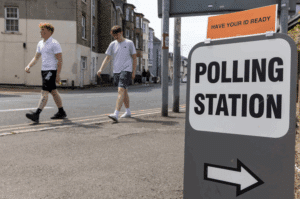
Andrew Aitchison/In Pictures via Getty ImagesIn July 2025, the United Kingdom approved a change to lower the national voting age from 18 to 16, set to take effect before the next general election. The decision will give roughly 1.6 million teenagers the right to vote in all UK elections, a shift that supporters say will invigorate democracy and critics warn could undermine it. 
Voting age debates have a long history in the UK and abroad. In 1969, Britain became one of the first countries to lower the voting age from 21 to 18, setting a precedent for broader suffrage. Calls to extend voting rights to 16- and 17-year-olds have gained traction over the past two decades, bolstered by Scotland’s decision to lower the voting age for its 2014 independence referendum, an event where turnout among 16- and 17-year-olds exceeded that of voters aged 18–24. 

The Current Proposal

The new policy:

  • Lowers the voting age from 18 to 16 for all UK general and local elections, as well as devolved government elections (such as those for the Scottish Parliament, Welsh Parliament, and Northern Ireland Assembly). 
  • Enfranchises an estimated 1.6 million additional citizens. 
  • Applies uniformly across England, Scotland, Wales, and Northern Ireland. 
  • Will be in place by the next general election, likely by 2029. 

Supporters of lowering the voting age to 16 emphasize that involving young people in elections could foster long-term civic engagement and boost overall turnout, particularly when voting is tied to issues that affect them directly, such as education, climate policy, or housing. Advocates also note that young people already contribute to society through work, taxes, and/or military service. However, critics counter that younger teens may lack the maturity and life experience necessary to make informed choices in national elections, raising concerns about voting competence and the quality of civic participation. Some also view the reform as politically strategic, potentially favoring parties that resonate with younger voters. They worry that expanding the electorate alone won’t guarantee a more knowledgeable or engaged democratic citizenry.  

In the classroom, this reform can serve as a springboard for discussion about youth participation in democracy. As a teacher, you might begin by asking students how lowering the voting age could reshape elections. Would it amplify young people’s concerns about certain issues? Would politicians change their campaign strategies if 16- and 17-year-olds could vote? Students could explore arguments on both sides: the potential for increased civic engagement and long-term voting habits versus concerns about maturity, political influence, and informed decision-making. Structured debates, simulations, or small-group discussions can encourage students to critically examine how a shift in the voting age might affect voter turnout, representation, and the overall health of democracy in the United States. 

Discussion Questions 

  1. What are the potential benefits and drawbacks of lowering the voting age in the United States? 
  2. How might earlier access to voting shape political participation later in life? 
  3. Should voting rights for 16- and 17-year-olds be connected to other responsibilities, such as paying taxes or serving in the military? 
  4. What role should schools play in preparing young people to vote responsibly? 
  5. What lessons can the United States learn from countries that already allow 16-year-olds to vote? 

As always, we encourage you to join the discussion with your comments or questions below.

Close Up is proud to be the nation’s leading nonprofit civic education organization, working with schools and districts across the country since 1971. If you would like to partner with us or learn more about our experiential learning programs, professional development, or curriculum design and consulting, contact us today! 


Sources

Featured Image Credit: Andrew Aitchison via Getty Images
BBC News: https://www.bbc.com/news/articles/c628ep4j5kno 
NPR: https://www.npr.org/2025/07/17/nx-s1-5471304/uk-lowers-voting-age-16 
Gov.UK: https://www.gov.uk/government/news/16-year-olds-to-be-given-right-to-vote-through-seismic-government-election-reforms 
Northeastern Global News: https://news.northeastern.edu/2025/07/22/uk-voting-age-16-impact/ 
Reuters: https://www.reuters.com/world/uk/cut-uk-voting-age-puts-new-group-political-spotlight-2025-07-21/?utm 
The Guardian: https://www.theguardian.com/commentisfree/2025/jul/17/16-year-olds-vote-countries-turnout-political-change?utm_
The Financial Times: https://www.ft.com/content/41421587-bc65-432a-a8ca-7368d39177c7?utm 


Book Bans in Schools and Libraries

Book banning—along with other ways of restricting public access to written expression—has been a common and controversial issue throughout the history of the United States. For example, Harper Lee’s novel, “To Kill A Mockingbird,” has been repeatedly banned in schools and public libraries across the country since it was published in 1960. Challenges to the book frequently cite racist or sexual subject matter as harmful to readers, especially children.1 However, the ways books are challenged and banned has started to change rapidly, becoming a national controversial issue in the last few years.

Until recently, challenges to books in schools and libraries were almost always from community members. They might object to a popular series, a specific author, or school or library lessons that include controversial titles. However, many of the bans in the last three years are linked to outside political organizations. At the same time, the number of books banned from public access has grown substantially. PEN America, a nonprofit that works to protect and expand access to written expression, reported a 33 percent increase in books banned in the 2022-2023 school year compared to the year prior.2 And last year, the American Library Association (ALA) found that nearly 2,500 books were challenged in libraries across the United States.3

Although such a large increase in book bans has concerned opponents of the restrictions, the content of the books being banned has become the bigger controversy. Many new bans promoted by political organizations target books containing a specific topic. In 2023, the ALA reported that almost 50 percent of titles challenged that year either included topics about people of color and/or LGBTQ+ individuals or were authored by individuals with those identities.4 Rep. Ayanna Pressley (D-Mass.) has been a particularly vocal critic of these types of bans. In December 2023, she introduced the Books Save Lives Act. Her bill sought to “push back on this dangerous trend” and “reaffirm the need for representative literature.”5

Supporters of these expanded book bans seek to restrict access to titles they find offensive, immoral, or age-inappropriate. Many supporters are parents or groups that believe parents have the right to control the content their children consume. One of the leading organizations supporting this position is Moms for Liberty, a social welfare and lobbying nonprofit with hundreds of chapters nationwide. Moms for Liberty and similar groups emphasize that certain topics like sexuality, racism, and violence should be removed from some public spaces so parents can better control when and how their kids learn about those issues. Moms for Liberty also supports candidates running for school board positions that control the books most available to children.6 Additionally, many parental rights groups create resources that are shared online to other supporters. For example, volunteers maintain the website Book Look, which features reviews of controversial books. Each review rates a book from zero to five based on its content, includes objectionable quotes from the text, and features a “profanity count” totaling the number of offensive words.7 In a review of “The Hate U Give,” for example, there is a warning of “excessive profanity, racism and racist commentary, and inexplicit sexual activities.”8

Those who oppose recent book bans argue that children benefit from exposure to writings that include diversity in characters, stories, cultures, and viewpoints. Some supporters of the Books Save Lives Act note how books have transformed their own lives. Author Maia Kobabe and co-founder of the Florida Freedom to Read Project Stephana Ferrell emphasized the importance of American children seeing themselves represented in literature. And during her floor speech announcing the bill, Rep. Pressley revealed that, after being sexually abused as a child, reading “I Know Why The Caged Bird Sings” by Maya Angelou helped her “move forward.”9 She said the representation of sexual abuse in the book made her feel less alone. Yet this novel has been challenged, banned, and restricted multiple times; in April 2025, it was banned from the library of the United States Naval Academy.10

Generally, both sides of the debate agree that literature is a form of media that can be very transformational and that children and teens can be impressionable. It is important to examine what content is accessible to our children; this fact is not disputed by supporters or opponents of book bans. Instead, those divided on this issue are trying to balance the security that young people need as they learn about difficult or more mature parts of life and the freedom to access ideas without government interference.

Discussion Questions

  1. Do you know of any efforts to ban books at your school or local library?
  2. How might book bans affect a child’s educational goals?
  3. What actions, if any, should the government take regarding this issue?
  4. Should laws require that some categories of books are accessible or inaccessible to children and teens?
  5. Who should have the final say in what books children read?

Related Posts

As always, we encourage you to join the discussion with your comments or questions below.

Close Up is proud to be the nation’s leading nonprofit civic education organization, working with schools and districts across the country since 1971. If you would like to partner with us or learn more about our experiential learning programs, professional development, or curriculum design and consulting, contact us today! 


Sources

[1] PBS: https://www.pbs.org/newshour/education/to-kill-a-mockingbird-remains-among-top-banned-classical-novels
[2] PEN America: https://pen.org/book-bans/2023-banned-book-list/
[3] American Library Association: https://www.ala.org/bbooks/book-ban-data
[4] Ibid.
[5] Office of Rep. Ayanna Pressley: https://pressley.house.gov/2023/12/14/pressley-unveils-bill-to-confront-rise-in-book-bans-ensure-inclusive-learning-environments/
[6] Moms for Liberty: https://www.momsforliberty.org/about/
[7] Book Look: https://www.booklook.info/public-book-reports
[8] Ibid.
[9] Rep. Ayanna Pressley: https://youtu.be/kC0dNMGeHBM?si=VHUKeVD0Myiiu3Y7
[10] New York Times: https://www.nytimes.com/2025/04/11/us/politics/naval-academy-banned-books.html


Tensions Increase Between China and Taiwan

In May 2024, Lai Ching-te was sworn in as the new president of Taiwan. Central to his campaign was rejecting any political claims to the island by mainland China (officially the People’s Republic of China or PRC) and establishing a fully independent Taiwan.1 This position is in clear opposition to the PRC’s “One China” principle, which views Taiwan as a breakaway Chinese province to be brought back under control. In response, Chinese authorities declared Taiwan’s new president responsible for increasing tensions between the two governments, which have been engaged in a power struggle for nearly 100 years.2 As tensions continue to rise, what actions, if any, should the United States take to protect Taiwan from Chinese control?

U.S.-Taiwan Relations

Currently, the United States maintains political connections with both China and Taiwan and has worked to maintain peace in the area while also providing support for the democratic government of Taiwan (officially the Republic of China or ROC). This position has historically required careful diplomacy because of the adversarial relationship between the PRC and ROC. The ROC once controlled all of China, but in 1949, ROC officials retreated to Taiwan after the PRC’s communist takeover of mainland China.3 The United States recognized the ROC as the Chinese government until 1978. That year, President Jimmy Carter identified the PRC as the lawful government of China and established formal diplomatic ties. The United States no longer acknowledged the ROC’s claim over China and adopted a “One China” policy where Taiwan is not considered an independent state. However, in 1979, Congress passed the Taiwan Relations Act, promising support, including military action, to help the island maintain self-governance.4

In the last decade, the tensions between the PRC and ROC have escalated with calls for Taiwanese independence and military drills in China. At the same time, the United States has strengthened relations with Taiwan despite hostile responses from China.5 In 2016, President-Elect Donald Trump took a phone call from Taiwan’s president, Tsai Ing-wen, who congratulated him on his election win; it was the first time a president or president-elect had spoken directly with a Taiwanese leader since 1979.6 Since then, both the Trump administration and former President Joe Biden’s administration have shifted direction from the decades of prior U.S.-Taiwan policy.7 Both presidents significantly increased military support for Taiwan, angering China and destabilizing the peace between China and Taiwan that previous U.S. officials worked hard to maintain.8

During the first Trump administration, two military sales worth over $1.7 billion provided Taiwan with advanced missiles, torpedoes, and parts for its aircraft and subsystems.9 The United States also increased naval activities and dispatched high-ranking officials to Taiwan in response to China’s increased military presence in the Taiwan Strait.10 Under the Biden administration in 2024, Congress passed an $8.12 billion aid package to Taiwan to counter Chinese military action.11 A second package in September 2024 provided additional financial support from the Department of Defense to improve Taiwanese military education and training.12

What Do Americans Think?

Those who support U.S. aid to Taiwan see protecting its democracy as a critical move for Taiwan’s safety and U.S. security in the region. Overall, Americans hold a positive view of Taiwan across party lines. A 2024 poll conducted by the Chicago Council on Global Affairs found that 62 percent of Americans see ties with Taiwan as strengthening national security and 59 percent support providing aid if China invades the island.13 However, a majority of Americans are opposed to sending U.S. troops to defend Taiwan in the event of an invasion.14 Supporters also highlight that Chinese control of Taiwan would threaten our economic stability. Taiwan manufactures 44 percent of all advanced semiconductors used in American electronics; the United States makes none.15 China could limit sales to the United States and prices would skyrocket.

Opponents, meanwhile, want to adhere to the “One China” policy and refrain from U.S. involvement between China and Taiwan, believing the status quo should be maintained to prevent Chinese retaliation. China has consistently criticized U.S. involvement and warned of consequences if support continues. In response to the 2024 military packages for Taiwan, Mao Ning, a representative of the PRC, stressed that the U.S. decision to help arm Taiwan will only push the country toward the danger of military conflict and that China stands strong against Taiwan independence. Officially, China “strongly condemns” the sale and says it “will take resolute countermeasures and take all measures necessary to firmly defend national sovereignty, security and territorial integrity.”16

What Will Happen Next?

The debate about the U.S. role in the conflict between Taiwan and China is one that has persisted through multiple presidential administrations. The United States simultaneously adheres to the “One China” policy and provides military aid to Taiwanese defense against PRC hostility through the Taiwan Relations Act. Overall, Americans support continued aid to Taiwan. However, tensions between the United States and China may shift as President Trump responds to the conflict. Already this year, President Trump has imposed tariffs on both countries and pressured Taiwan to increase its spending on American-made products.17 He has also pushed Taiwan to increase its own military budget.18 Though the United States has been one of Taiwan’s strongest supporters, there is uncertainty about whether President Trump would have the United States come to Taiwan’s aid if China invades.19

Discussion Questions

  1. What benefits and consequences do you see for the United States if the Trump administration continues to provide Taiwan more military support?
  2. Do you think President Trump’s actions on this issue will affect U.S. relations with countries other than China? Why or why not?
  3. How do you think the Trump administration should handle the growing tensions between China and Taiwan?
  4. How far should U.S. support for Taiwan go?

Related Posts

As always, we encourage you to join the discussion with your comments or questions below.

Close Up is proud to be the nation’s leading nonprofit civic education organization, working with schools and districts across the country since 1971. If you would like to partner with us or learn more about our experiential learning programs, professional development, or curriculum design and consulting, contact us today! 


Sources

[1] United States Institute of Peace: https://www.usip.org/publications/2024/06/taiwans-new-president-faces-tensions-china-and-domestic-division
[2] U.S. Congress: https://crsreports.congress.gov/product/pdf/IF/IF12503/1
[3] U.S. Department of State: https://history.state.gov/milestones/1977-1980/china-policy
[4] U.S. Congress: https://www.congress.gov/bill/96th-congress/house-bill/2479/all-info#:~:text=Taiwan%20Relations%20Act%20%2D%20Declares%20it,other%20people%20of%20the%20Western
[5] Voice of America: https://www.voanews.com/a/taiwan-seeks-clarity-on-trump-administration-policy-amid-chinese-pressure/7915065.html
[6] New York Times: https://www.nytimes.com/2016/12/02/us/politics/trump-speaks-with-taiwans-leader-a-possible-affront-to-china.html
[7] Global Taiwan Institute: https://globaltaiwan.org/2024/11/taiwan-policy-under-the-second-trump-administration/
[8] Brookings Institution: https://www.brookings.edu/articles/does-the-united-states-need-to-update-its-taiwan-policy/
[9] Council on Foreign Relations: https://www.cfr.org/in-brief/us-military-support-taiwan-whats-changed-under-trump
[10] University of Navarra: https://www.unav.edu/web/global-affairs/biden-trump-beyond-the-strategic-ambiguity-towards-taiwan
[11] Reuters: https://www.reuters.com/world/us/whats-us-houses-foreign-aid-bills-ukraine-israel-taiwan-2024-04-17/
[12] Al Jazeera: https://www.aljazeera.com/news/2024/9/30/us-approves-567m-in-military-support-for-taiwan
[13] Chicago Council on Global Affairs: https://globalaffairs.org/research/public-opinion-survey/taiwan-americans-favor-status-quo
[14] Ibid.
[15] Yale School of the Environment: https://e360.yale.edu/features/taiwan-energy-dilemma
[16] China Military Online: http://eng.chinamil.com.cn/VOICES/MinistryofForeignAffairs/16343762.html
[17] Associated Press: https://apnews.com/article/taiwan-united-states-trade-tariffs-president-0f4438f7778ae2626531575befee754e
[18] New York Times: https://www.nytimes.com/2025/05/22/world/asia/trump-china-taiwan-security.html
[19] Ibid.


Should the Department of Education Be Abolished?

On March 3, the Senate confirmed Linda McMahon as the thirteenth secretary of education.1 Secretary McMahon has pledged to dismantle the Department of Education in what she calls its “final mission,” and on March 11, the Department announced it was cutting nearly 50 percent of its workforce.2 President Donald Trump is expected to sign an executive order directing Secretary McMahon to “take all necessary steps to facilitate the closure of the Education Department,” though the Department cannot be abolished unilaterally by the executive branch; this would require an act of Congress.3

What Is the Department of Education?

The Department of Education that we have today was created by Congress in 1979 as a cabinet-level department within the executive branch of the federal government.4 It consolidated resources, staff, and programs across other executive departments and agencies into one centralized place in an effort to advance its goals of student success and opportunity in education.5 It is the smallest of the 15 cabinet departments, with approximately 4,200 employees.6 However, its budget is the third largest, after the Department of Defense and the Department of Health and Human Services.7

While the Department of Education is relatively modern and education in the United States is primarily a responsibility of state and local governments, the federal government has played a significant role in education policy since the 1860s. After the Civil War, it began collecting data and offering grants to aid states in creating schools, training teachers, and covering the cost of tuition for students.8 It funded school districts and provided loans for higher education during the post-World War II education boom and Cold War-era focus on the fields of science, technology, engineering, and mathematics.9 And during the civil rights era, it enforced equal protections in schools for students and teachers regardless of their race, color, national origin, sex, religion, age, or disability.10

In 2020-2021, approximately 11 percent of elementary and secondary public school funding was from federal sources, 46 percent was from state sources, and 44 percent was from local sources. With an annual budget of $268 billion, the Department of Education still primarily focuses on funding and research. It administers grants for schools and students, issues loans to students, collects and publishes data, recommends best practices, and ultimately ensures equal access to education for students across the country.11 Sixty percent of its funding goes directly to financial aid programs to help low-income students afford higher education.12 The Department of Education does not establish schools, set education standards, set graduation requirements, or create curricula.13

Why Is the Trump Administration Trying to Abolish the Department of Education?

There have been longstanding calls from the Republican Party to abolish the Department of Education. Mere months after the Department was created, the 1980 Republican platform stated that the party “supports deregulation by the federal government of public education, and encourages the elimination of the federal Department of Education.”14 Republican presidents since Ronald Reagan have called for the federal government to be scaled back in size and scope, preferring issues such as education to be left solely to the states. Despite this, when put to Congress, efforts to abolish the Department of Education have been soundly defeated across party lines in both the House of Representatives and the Senate.15

Secretary McMahon argues that the country does not need the Department of Education, and President Trump has routinely criticized it as unnecessary, wasteful, and ideologically compromised.16 In President Trump’s first term, his secretary of education took steps to curtail the work of the Department by shrinking the size of its workforce, reducing its budget, scaling back nondiscrimination protections, and rescinding guidance tied to the use of federal funds.17 In the first weeks of his second term, President Trump signed an executive order to deny funding for schools that he claims promote “radical, anti-American ideologies” that “deliberately [block] parental oversight.”18 And last month, the Department of Government Efficiency cut over $900 million in research contracts from the Department.19

What Do Supporters and Opponents Say?

President Trump’s criticisms of the Department of Education reflect the larger views of those who also support its abolition and are distrustful of the federal government, especially in the wake of the COVID-19 lockdowns, mask mandates, and the prevalence of diversity, equity, and inclusion initiatives.20 These supporters advocate for more power to states, school boards, and especially parents to make educational choices for their students, rather than relying on a bureaucracy in Washington. They advocate for school choice programs and funding for private schools, along with parental review of school curricula and book bans on local and state levels. Additionally, they cite the Department’s large budget and stagnant student test scores as further proof that it is ineffective at achieving its goals.21

Those who oppose abolishing the Department of Education reiterate that it is not involved in setting school standards or creating curricula. Instead, they underscore the importance of the Department’s role in providing funds and enforcing antidiscrimination laws. Pell Grants administered by the Department support one-third of low-income college students, and half of all undergraduates in the United States rely on some form of federal financial aid.22 Antidiscrimination laws make sure students have equal access and opportunity to succeed without burden or bias. With inequities growing between wealthier and poorer school districts and students, they see the Department of Education as vital, especially as students continue to struggle academically in the wake of the pandemic.23

Discussion Questions

  1. How would you rate the quality of your school and your education?
  2. How important of an issue is college affordability to you?
  3. What are the most persuasive reasons for abolishing the Department of Education?
  4. What are the most persuasive reasons against abolishing the Department of Education?
  5. Would you advocate for keeping or abolishing the Department of Education? Why?
  6. What role, if any, do you think the federal government should play in education policy?

Related Posts

As always, we encourage you to join the discussion with your comments or questions below.

Close Up is proud to be the nation’s leading nonprofit civic education organization, working with schools and districts across the country since 1971. If you would like to partner with us or learn more about our experiential learning programs, professional development, or curriculum design and consulting, contact us today! 


Sources

[1] U.S. Department of Education: https://www.ed.gov/about/news/press-release/us-senate-confirms-linda-mcmahon-13th-secretary-of-education-0
[2] Politico: https://www.politico.com/news/2025/03/04/linda-mcmahon-education-department-final-mission-00210057; CNN: https://www.cnn.com/2025/03/11/politics/department-of-education-cuts/index.html
[3] CNN: https://www.cnn.com/2025/03/06/politics/trump-education-department-shut-down-order/index.html
[4] U.S. Department of Education: https://www.ed.gov/about/ed-overview/mission-of-the-us-department-of-education
[5] U.S. Department of Education: https://www.ed.gov/about/ed-overview/federal-role-in-education
[6] New York Times: https://www.nytimes.com/2025/03/07/us/politics/education-department-mcmahon-trump.html
[7] U.S. Department of Education: https://www.ed.gov/about/ed-overview/federal-role-in-education
[8] Ibid.
[9] The Hechinger Report: https://hechingerreport.org/opinion-the-new-administration-could-be-on-the-verge-of-destroying-public-education-as-we-know-it/
[10] U.S. Department of Education: https://www.ed.gov/about/ed-overview/federal-role-in-education
[11] Yahoo News: https://www.yahoo.com/news/why-trump-wants-to-end-the-department-of-education–and-what-will-change-if-he-succeeds-214316185.html; National Center for Education Statistics: https://nces.ed.gov/programs/coe/indicator/cma/public-school-revenue
[12] Ibid.
[13] U.S. Department of Education: https://www.ed.gov/about/ed-overview/an-overview-of-the-us-department-of-education–pg-3
[14] The American Presidency Project: https://www.presidency.ucsb.edu/documents/republican-party-platform-1980
[15] New York Times: https://www.nytimes.com/2025/03/06/us/politics/trump-republicans-education-department.html
[16] New York Times: https://www.nytimes.com/2025/03/07/us/politics/education-department-mcmahon-trump.html
[17] Center for American Progress: https://www.americanprogress.org/article/trump-administrations-slow-steady-undoing-department-education/
[18] White House: https://www.whitehouse.gov/presidential-actions/2025/01/ending-radical-indoctrination-in-k-12-schooling/
[19] New York Times: https://www.nytimes.com/2025/02/11/us/politics/musk-doge-education-data.html?smid=url-share
[20] CNN: https://www.cnn.com/2024/02/03/us/moms-for-liberty-scandal-opposition/index.html
[21] New York Times: https://www.nytimes.com/2025/03/06/us/politics/trump-republicans-education-department.html
[22] Yahoo News: https://www.yahoo.com/news/why-trump-wants-to-end-the-department-of-education–and-what-will-change-if-he-succeeds-214316185.html
[23] New York Times: https://www.nytimes.com/2025/01/29/us/reading-skills-naep.html


Steel, Soybeans & Security: The Debate on Tariffs Continues

On February 25, President Donald Trump announced that new tariffs on goods from Canada and Mexico would go into effect on March 4.1 President Trump revived the use of tariffs in 2018, ending seven decades of emphasis on free trade economic policies. Since 2018, both Presidents Trump and Joe Biden have enacted several major tariffs, significantly impacting worldwide trade.2

Tradeoffs of Free Trade

Tariffs were historically used to protect domestic businesses from imports (goods bought from other countries). Once common in overseas trade, tariffs began disappearing after World War II in favor of free trade agreements. Removing tariffs allowed Americans to buy imports at low prices.3 Imported products that were cheap to make and easy to ship quickly replaced more expensive American-made goods.4 Although consumers benefited from low prices, American manufacturers couldn’t keep up. Communities across the country suffered as local factories closed and residents lost their jobs.5

One way foreign countries keep costs down is by tolerating poor working conditions and low pay. To cut prices even more, some foreign governments also spend taxpayer dollars supporting major industries, sometimes spending less on education or infrastructure.6 The difference in business costs can be staggering. For example, American minimum wage laws require businesses to pay employees anywhere from three to ten times more than what must be paid to workers in China.7 Consequently, many American companies moved their factories overseas to lower manufacturing costs and pass those savings to their customers.

How Do Americans Feel About Tariffs?

Groups that have supported recent tariffs include labor unions, human rights activists, and communities hurt by free trade. Supporters argue that tariffs help American businesses compete with cheaper imports made with unfair or inhumane business practices.8 Additionally, President Trump has declared that the U.S. trade deficit threatens the economy. A trade deficit occurs when a country imports more goods than it sells to foreign buyers. In 2016, the year before President Trump took office for the first time, the trade deficit was $481 billion.9 Furthermore, leaders in both political parties have supported tariffs; not only did President Biden continue many Trump-era tariffs but he enacted additional tariffs targeting China.10

National security experts also caution that imports are a serious threat to government secrets and intellectual property. Some imported goods have compromised sensitive data with hidden programming, and importing critical resources like energy or steel puts the United States in a vulnerable economic position.11 Tariffs can help American industries capture consumer spending, allowing them to grow. A strong manufacturing sector protects the economy from global shortages.

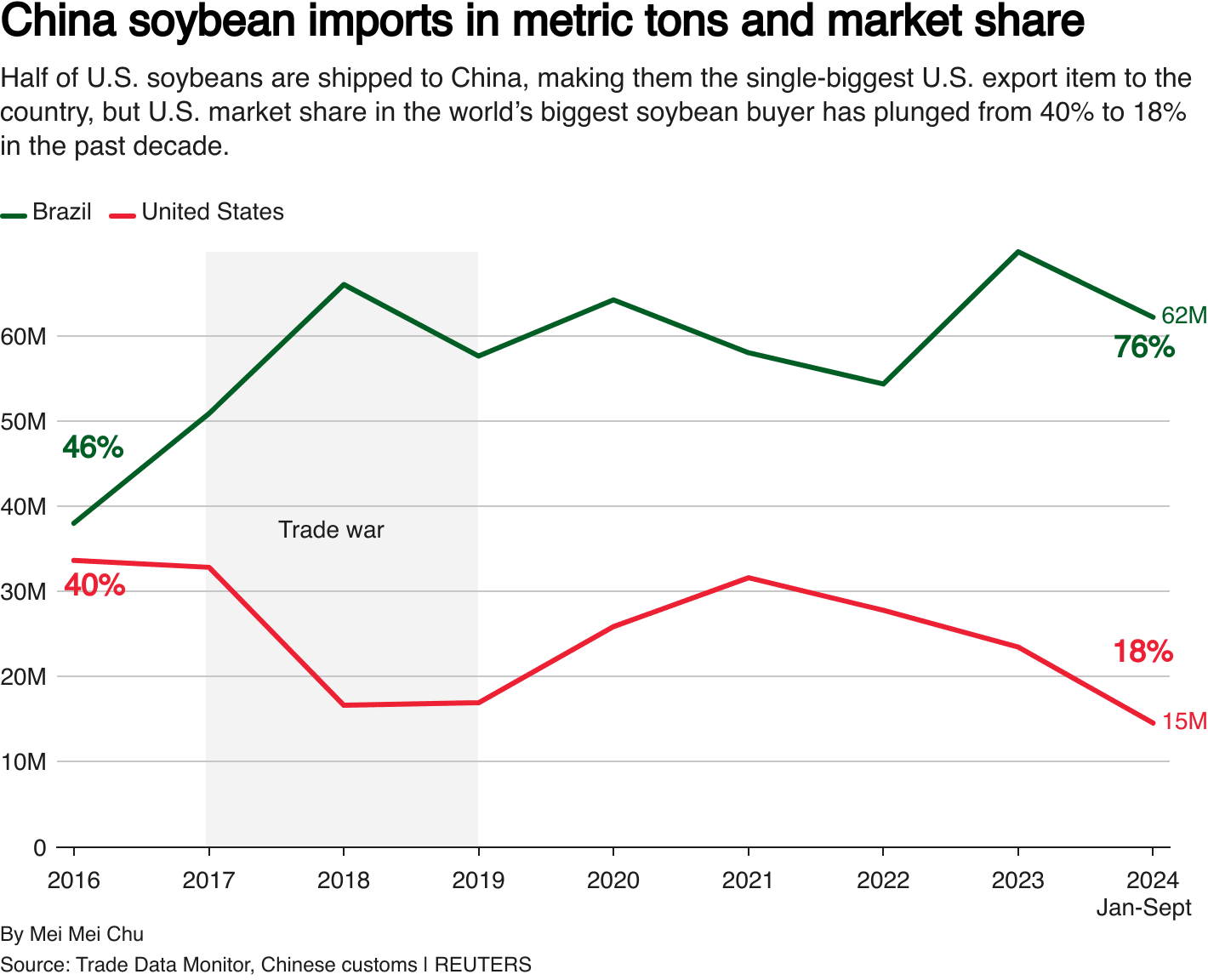
In contrast, most economists argue that tariffs harm Americans.12 Businesses simply raise prices on imported goods, leaving consumers without cheaper alternatives. Americans buy less, and the economy slows. Furthermore, countries have retaliated by enacting their own tariffs on American goods. For example, after tariffs went into effect in 2018, Chinese officials targeted Midwest farmers by implementing high tariffs on American soybeans and shifted soybean trade to Brazil. In the years since, American farmers have needed billions of dollars in federal aid to recover from the loss in revenue.13 Opponents also point out that tariffs did nothing to balance trade, as America’s trade deficit has more than doubled in the last seven years.14 Currently, economists predict that the new 2025 tariff proposals will increase inflation; consumers will pay more, and businesses will suffer.15

Support for tariffs among some groups of Americans has grown, especially among Republicans and independents living in areas where decades of free trade devastated the local economy. However, research indicates that tariffs have hurt Americans’ wallets and cost over 170,000 jobs over the last seven years.16 If tariffs are harming the economy, why hasn’t support declined? Polling indicates that opinions on tariffs, just as on other issues, are based on a combination of values, not just data points or dollars—an important consideration in policy discussions.

Discussion Questions

  1. What might make an American industry vulnerable to competition from imports?
  2. In your opinion, what is the greatest benefit that tariffs offer industries or the economy? What is the greatest drawback of tariffs?
  3. Should the United States continue using tariffs? Why or why not?

As always, we encourage you to join the discussion with your comments or questions below.

Close Up is proud to be the nation’s leading nonprofit civic education organization, working with schools and districts across the country since 1971. If you would like to partner with us or learn more about our experiential learning programs, professional development, or curriculum design and consulting, contact us today! 


Sources

[1] CNBC: https://www.cnbc.com/2025/02/24/trump-says-tariffs-on-canada-and-mexico-will-go-forward.html
[2] CNN: https://www.cnn.com/2024/09/13/politics/china-tariffs-biden-trump/index.html
[3] PBS: https://www.pbs.org/newshour/economy/trump-favors-huge-new-tariffs-how-do-they-work
[4] National Bureau of Economic Research: https://www.nber.org/system/files/chapters/c13861/c13861.pdf
[5] New York Times: https://www.nytimes.com/2024/09/03/magazine/nafta-tarriffs-economy-trump-kamala-harris.html
[6] George Washington University Law: https://studentbriefs.law.gwu.edu/ilpb/2021/10/28/fast-fashion-getting-faster-a-look-at-the-unethical-labor-practices-sustaining-a-growing-industry/
[7] Stanford Review for Economic Policy Research: https://siepr.stanford.edu/publications/policy-brief/low-wage-earners-hit-hardest-trade-china
[8] Business and Human Rights Resource Center: https://media.business-humanrights.org/media/documents/files/documents/Final_Blog_Post_Tariff_Act_March_2020_002_0.pdf; Reuters. https://www.reuters.com/world/us/us-lawmakers-take-aim-chinas-trade-practices-2025-02-24/
[9] The Fulcrum: https://thefulcrum.us/governance-legislation/trumps-trade-deficit
[10] CNN: https://www.cnn.com/2024/09/13/politics/china-tariffs-biden-trump/index.html
[11] BBC: https://www.bbc.com/news/world-asia-china-64206950
[12] PBS: https://www.pbs.org/newshour/economy/trump-favors-huge-new-tariffs-how-do-they-work
[13] University of Illinois, Farm Policy News: https://farmpolicynews.illinois.edu/2025/02/farm-income-to-increase-in-2025-thanks-to-federal-aid/
[14] Brookings Institution: https://www.brookings.edu/articles/more-pain-than-gain-how-the-us-china-trade-war-hurt-america/
[15] USA Today: https://www.usatoday.com/story/money/2025/02/16/trump-tariffs-inflation-economy-impact/78398446007/
[16] Massachusetts Institute of Technology, Department of Economics: https://economics.mit.edu/sites/default/files/2024-01/Help%20for%20the%20Heartland%20-%20The%20Employment%20and%20Electoral%20Effects%20of%20the%20Trump%20Tariffs%20in%20the%20United%20States.pdf


A Marshall Plan for Tribal Nations

“The United States should do whatever it can to assist in the return of normal economic health in the world, without which there can be no political stability and no assured peace. –Secretary of State George C. Marshall1

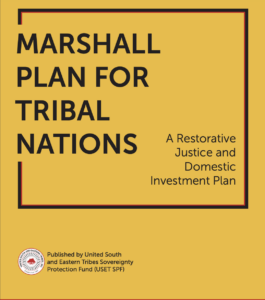
A Marshall Plan for Tribal Nations has gained support as tribal leaders and advocates call on the United States to fulfill its longstanding trust and treaty obligations.3 The phrase invokes the European Recovery Program—commonly known as the Marshall Plan—which the United States implemented after World War II to rebuild war-torn Europe. Today, Indigenous leaders are advocating for a similarly ambitious investment to repair the harm caused by centuries of policies that have left tribal nations underfunded and deprioritized.3

The United South and Eastern Tribes Sovereignty Protection Fund (USET SPF) spearheads advocacy for this proposal. This blog post reflects the perspectives and language of the Marshall Plan for Tribal Nations: A Restorative Justice and Domestic Investment Plan published by USET SPF. It provides an overview of the proposed plan and includes discussion questions and further resources to help educators explore this issue with students.

Historical Context: Tribal Nations and the United States

Tribal nations have long been categorized as sovereign political entities, as reaffirmed by the U.S. Constitution,4 treaties, federal statutes, and Supreme Court decisions.5 Despite this legal political status, the United States has continuously failed to fulfill its trust and treaty obligations. This negligence has led to widespread disparities in infrastructure, education, health care, and economic opportunity within tribal communities.

The federal government has acted to terminate, assimilate, and destabilize tribal nations through forced removal, violence, broken treaties, and systematic underfunding. Even in the modern era, federal appropriations for tribal nations have fallen short of what is necessary to meet basic needs.6 This has led to significant gaps in services and infrastructure that are commonplace in other communities.

What Is the Marshall Plan for Tribal Nations?

“What we are talking about is not an ask for handouts. This is about the United States living up to the promises that it made to Tribal Nations—promises that were made in exchange for our land and resources.” –Kitcki Carroll (Cheyenne and Arapaho Tribes of Oklahoma), Executive Director of USET and USET SPF

The Marshall Plan for Tribal Nations is a proposal to rectify the historical injustices and ongoing neglect of trust and treaty obligations through a significant investment that acknowledges and begins to address the United States’ debt to Indigenous peoples. Key components of the plan include:

  • A Major Financial Investment: Modeled on the Marshall Plan for Europe, the proposal calls for a large-scale investment in tribal nations to establish a baseline of economic and social stability.
  • Creation of a Department of Tribal Nation Relations: This proposed cabinet-level department would oversee the execution of trust and treaty obligations, ensuring funding is allocated effectively and in consultation with tribal leaders.
  • Mandatory, Direct Funding: The proposal shifts federal funding for tribal programs from discretionary to mandatory and ensures that funds are allocated directly to tribal governments, rather than through competitive grants.
  • Tribal Consultation and Consent: The proposal strengthens tribal nations’ ability to exercise self-governance by requiring federal agencies to obtain direct consent, rather than just consulting with tribal leaders, before implementing policies affecting their communities.
  • Infrastructure and Economic Development: Investments in roads, housing, broadband access, health care facilities, schools, and economic opportunities are tailored to the needs of tribal nations.

Comparing the European and Tribal Nations Marshall Plans

The original Marshall Plan allocated approximately 1-2 percent of U.S. gross domestic product (GDP) to rebuild European nations, providing over $13 billion (equivalent to nearly $135 billion today) for a four-year program.7 By contrast, the United States has historically underfunded tribal nations, with appropriations amounting to just 0.07 percent of the value of land taken from Indigenous peoples. If the United States were to invest at a level comparable to the European Marshall Plan, this would translate to hundreds of billions of dollars dedicated to rebuilding tribal nations.

Why This Matters

Understanding the Marshall Plan for Tribal Nations allows students to engage with key civics concepts, including federal treaty obligations and trust responsibilities, tribal sovereignty, and the long-term impacts of federal Indian policy. This allows students to critically analyze how policy decisions shape tribal self-governance and explore restorative justice in U.S.-tribal nation relations.

Discussion Questions

  1. What were the goals and outcomes of the original Marshall Plan for Europe? How does the Marshall Plan for Tribal Nations compare?
  2. How has the United States historically failed to fulfill its trust and treaty obligations to tribal nations? What have been the consequences?
  3. What would a fully funded and properly implemented Marshall Plan for Tribal Nations mean for Indigenous communities?
  4. What are the potential challenges or criticisms of implementing a Marshall Plan for Tribal Nations?
  5. How does learning about this issue change your perspective on tribal nation rights and U.S. policy?

Other Resources


As always, we encourage you to join the discussion with your comments or questions below.

Close Up is proud to be the nation’s leading nonprofit civic education organization, working with schools and districts across the country since 1971. If you would like to partner with us or learn more about our experiential learning programs, professional development, or curriculum design and consulting, contact us today! 


Sources

Featured Image Credit: USET SPF
[1] https://www.marshallfoundation.org/the-marshall-plan/speech
[2] https://www.nihb.org/resource/nihb-resolution-22-09-on-support-for-a-marshall-plan-for-tribal-nations/
[3] https://www.congress.gov/118/meeting/house/116885/documents/HHRG-118-II24-20240320-SD004.pdf
[4] https://constitution.congress.gov/constitution/article-6/
[5] https://narf.org/category/tribal-sovereignty
[6] https://www.gao.gov/products/gao-25-107674#:~:text=Tribal%20applicants%20experience%20systemic%20barriers,to%20help%20alleviate%20these%20barriers.
[7] Marshall Plan (1948). Retrieved October 22, 2024, from National Archives: https://www.archives.gov/milestone-documents/marshall-plan


Is Offshore Wind a Feasible Renewable Energy Source?

On January 20, his first day back in office, President Donald Trump issued an executive order that stops new offshore wind projects from obtaining lease permits, halting development meant to power over 12 million homes.1 At a rally later that day, President Trump characterized wind turbines as ugly and harmful to property values and to the environment.2

What is Offshore Wind?

Wind farms generate energy from natural winds that spin the blades of large wind turbines. Wind turbines offer a renewable alternative to the burning of fossil fuels such as oil and natural gas. Renewable energy (energy from Earth’s natural forces), unlike energy from burning fossil fuels, does not emit the greenhouse gases that are increasing global temperatures. Climate scientists and activists argue that replacing fossil fuels with renewable energy sources is necessary to limit climate change and future devastating effects on Earth.3 Wind farms built offshore, in the ocean or other large bodies of water, harness large amounts of wind energy from unobstructed coasts.

There are two main types of offshore wind turbines: floating turbines and fixed-bottom turbines. They differ in how they are attached to the ocean floor. Cables secure floating turbines, while fixed-bottom turbines are built directly on the ocean floor. Fixed-bottom turbines are the most common—they are easier and cheaper to install—but they can only be built in shallow water.4 The United States has an estimated 1.5 terawatts (equal to 1,500 gigawatts) of fixed-bottom offshore wind potential—enough energy to power the entire country.5

Currently, there are only three fully operational offshore wind farms in the United States. The 132-megawatt South Fork Wind Farm is the newest offshore wind farm and operates off the coast of Long Island, New York. Completed in December 2023, this project was the first commercial-scale wind farm in the country.6 Generating more offshore wind infrastructure could significantly decrease American dependence on fossil fuels and reduce energy costs, but new projects require a large amount of money to fund construction as well as approval and guidance from multiple government agencies. Elected officials now must decide: should the government support more offshore wind projects?

The Debate Over Offshore Wind

Supporters of offshore wind note that one of its major benefits is its capacity to generate large amounts of energy, compared to less efficient forms of renewable energy like onshore wind farms. Because wind is stronger and more consistent over bodies of water, offshore turbines can generate twice as much energy as those on land.7 Offshore wind farms are typically built several miles off the coast and are minimally visible from shore. Additionally, coasts have fewer obstructions and building limitations, a problem that wind farms on land commonly face. Furthermore, investment in offshore wind creates jobs and economic growth in local communities because workers are needed to maintain turbines and connect wind farms to the rest of the electric grid. Finally, higher offshore wind capacity can contribute to greater energy independence by increasing the amount of energy produced in the United States and thereby reducing America’s reliance on foreign sources of energy.8

Opponents, however, believe the benefits of offshore wind are outweighed by costs and environmental disruption.9 For offshore wind to be viable, policy leaders must grant developers more money and change regulations at all levels of government. The approval process can take years of negotiating with communities, government agencies, and other industries, such as the fishing industry, which can lead to costly delays. Additionally, constructing offshore turbines, especially drilling for fixed-bottom models, threatens vulnerable ecosystems.10 Finally, coastal communities frequently oppose any changes to treasured shoreline views. For example, the Vineyard Wind project off the coast of Martha’s Vineyard, Massachusetts, faced significant opposition from residents who were concerned about turbines interrupting the natural coastline view surrounding the island.12

Many policymakers and voters agree on a need to transition away from fossil fuels, but the federal government has yet to develop a unified set of policy actions. Offshore wind offers an opportunity to generate large amounts of renewable energy, but Americans must decide if its potential is worth the significant advocacy and investment it requires.

Discussion Questions

  1. What factors should the government consider when deciding to approve or deny offshore wind projects? Which factors are the most important in this decision? Why are they important?
  2. Why might some people prioritize preserving ocean views over increasing renewable energy infrastructure?
  3. How much disruption or damage to ocean ecosystems, if any, is acceptable in order to construct renewable energy projects?
  4. How should the opinions of local residents shape plans for renewable energy projects?

As always, we encourage you to join the discussion with your comments or questions below.

Close Up is proud to be the nation’s leading nonprofit civic education organization, working with schools and districts across the country since 1971. If you would like to partner with us or learn more about our experiential learning programs, professional development, or curriculum design and consulting, contact us today! 


Sources

[1] CNBC: https://www.cnbc.com/2025/02/16/trumps-broadside-against-wind-industry-puts-projects-that-could-power-millions-of-homes-at-risk.html
[2] FactCheck.org: https://www.factcheck.org/2025/02/what-to-know-about-trumps-executive-order-on-wind-energy/
[3] Intergovernmental Panel on Climate Change: https://www.ipcc.ch/sr15/chapter/spm/
[4] National Renewable Energy Laboratory: https://www.nrel.gov/wind/fixed-bottom-offshore-webinar.html
[5] Bipartisan Policy Center: https://bipartisanpolicy.org/blog/the-latest-headwinds-and-tailwinds-for-u-s-offshore-wind/
[6] Department of Energy:  https://www.energy.gov/eere/wind/articles/top-10-things-you-didnt-know-about-offshore-wind-energy
[7] The Renewable Energy Hub: https://www.renewableenergyhub.co.uk/blog/pros-and-cons-of-offshore-energy
[8] World Economic Forum: https://www.weforum.org/agenda/2022/11/offshore-wind-farms-future-renewables/
[9] The Renewable Energy Hub: https://www.renewableenergyhub.co.uk/blog/pros-and-cons-of-offshore-energy
[10] The Renewable Energy Hub: https://www.renewableenergyhub.co.uk/blog/pros-and-cons-of-offshore-energy
[11] The Providence Journal: https://www.providencejournal.com/story/news/local/2021/08/26/vineyard-wind-power-project-sued-over-impact-whales/5600298001/


USAID and Cutting International Aid

On his first day back in office, President Donald Trump signed an executive order that implemented a 90-day freeze on aid to other countries. Since then, the offices of the U.S. Agency for International Development (USAID) have closed, staff have been furloughed, and there have been more funding freezes. The formerly semi-autonomous agency is now under the leadership of Secretary of State Marco Rubio. Tech billionaire Elon Musk, who leads the new advisory body called the Department of Government Efficiency (DOGE), has targeted USAID and foreign aid when advocating for cutting the federal budget.

What is USAID?

USAID was founded by an act of Congress in 1961, when President John F. Kennedy wanted a more efficient way to expand U.S. influence in the developing world by providing money and other forms of assistance. This was during the Cold War when the United States was competing with the Soviet Union for power and influence across the globe. The Foreign Affairs Reform and Restructuring Act, passed in 1998, established USAID as its own agency and largely separated it from the State Department. It is an agency within the State Department, which manages the United States’ relations with other countries, including our embassies abroad.

USAID funds an array of humanitarian projects around the world, including those related to providing clean water, infrastructure, and health care. The State Department provides broad foreign policy goals to USAID, but the agency decides on the specific projects to achieve those goals. Generally, independent private contracting companies bid on the projects that USAID funds.

Congress appropriated $66.1 billion for foreign aid in fiscal year 2023. That works out to 1.2 percent of that year’s total federal expenditure, which was more than $6.1 trillion. USAID administers around 60 percent of foreign aid.

Why Does the United States Provide Assistance to Other Countries?

There are many reasons countries provide foreign aid to other nations beyond simply helping people living in poverty or conflict.

  • Foster positive relations with other countries. A country can leverage the foreign aid it gives, and that resulting relationship, to get preferential treatment later. For example, China has spent nearly $680 billion since 2013 on its Belt and Road Initiative, funding infrastructure projects in 150 different countries. The project is meant to increase Chinese trade and influence around the world.
  • Promote global stability. This was the primary goal of the Marshall Plan, when the United States gave Europe $13.3 billion to rebuild after World War II. A stable Europe was economically beneficial to the United States, and there was fear that the Soviet Union could further expand its sphere of influence from Eastern Europe if Western Europe remained fragile.
  • Prevent the global spread of disease. Treating and preventing diseases from spreading is another way to promote global stability, as diseases (such as COVID-19) can be destabilizing. The United States funds several initiatives to curb infectious diseases; one of the most successful has been the U.S. President’s Emergency Plan for AIDS Relief (PEPFAR). The United States has invested over $100 billion in PEPFAR since 2003, providing developing countries facing HIV epidemics with medicine, medical care, and preventative resources.

Why Has President Trump Decided to Cut Funding to USAID?

President Trump and Musk argue that USAID is full of fraud and waste. President Trump has also said that the projects that USAID funds are not in line with current U.S. foreign policy goals, and that the agency is being run by “radical lunatics.” On February 3, the White House published a list of USAID projects that it said were evidence of waste and abuse, including $1.5 million to “advance diversity, equity, and inclusion in Serbia’s workplaces and business communities”; $70,000 for a production of a “DEI musical” in Ireland; $2.5 million for electric vehicles for Vietnam; and millions of dollars to the EcoHealth Alliance, a U.S.-based nongovernmental organization which was allegedly involved in research at the Wuhan Institute of Virology.

Musk has made unsubstantiated claims about USAID’s role in the COVID-19 pandemic, and that it is a criminal organization led by the far left. The executive order that President Trump signed said that foreign aid “serves to destabilize world peace by promoting ideas in foreign countries that are directly inverse to harmonious and stable relations internal to and among countries.”

Secretary Rubio has argued that USAID has lost its focus and abandoned the “national interest,” citing complaints from U.S. officials and foreign leaders. “They have basically evolved into an agency that believes that they’re not even a U.S. government agency, that they are out—they’re a global charity, that they take the taxpayer money, and they spend it as a global charity irrespective of whether it is in the national interest or not in the national interest,” said Secretary Rubio. “One of the most common complaints you will get if you go to embassies around the world from State Department officials and ambassadors and the like is USAID is not only not cooperative—they undermine the work that we’re doing in that country, they are supporting programs that upset the host government for whom we’re trying to work with on a broader scale, and so forth.”

What Has the Response Been?

Republicans, who have typically pushed to give the State Department more control of its policy and funds, have been largely supportive of scrutinizing USAID spending. “I think the administration has every right to demand accountability and transparency in all these programs,” said Senate Majority Whip John Barrasso (R-Wyo.).

Democrats, who have typically promoted USAID autonomy and authority, say that USAID has been authorized by Congress, so President Trump cannot legally dissolve it or allow the State Department to take over. USAID workers and contracting companies have sued, saying Congress decides how the country spends money, so they say the president cannot legally refuse to spend money that Congress has directed the government to spend. Additionally, USAID workers stationed in the Democratic Republic of the Congo are suing the administration for money they spent when they were forced to evacuate and the agency had already stopped paying for employee travel.

Farmers are also concerned about funding cuts. American farms supply about 41 percent of the food aid distributed by USAID. Food worth $340 million, including rice, wheat, and soybeans, is left stranded in the United States.

Discussion Questions

  1. Do you think foreign aid is an effective tool of foreign policy? Why or why not?
  2. What are the best arguments for providing foreign aid?
  3. What are the best arguments against providing foreign aid?
  4. Do you agree or disagree with the decision to cut funding for USAID? Explain your reasoning.

More Resources

As always, we encourage you to join the discussion with your comments or questions below.

Close Up is proud to be the nation’s leading nonprofit civic education organization, working with schools and districts across the country since 1971. If you would like to partner with us or learn more about our experiential learning programs, professional development, or curriculum design and consulting, contact us today! 


Sources

https://apnews.com/article/usaid-foreign-aid-freeze-trump-peter-marocco-8253d7dda766df89e10390c1645e78aa
https://www.cfr.org/backgrounder/chinas-massive-belt-and-road-initiative#chapter-title-0-4
https://www.kff.org/policy-watch/the-status-of-president-trumps-pause-of-foreign-aid-and-implications-for-pepfar-and-other-global-health-programs/
https://crsreports.congress.gov/product/pdf/R/R48150#:~:text=Congress%20provided%20%2466.1%20billion%20in%20foreign%20assistance%20appropriations%20in%20FY2023
https://www.state.gov/about-us-pepfarhttps://foreignpolicy.com/2025/02/05/usaid-trump-musk-rubio-state-department/
https://www.bbc.com/news/articles/c23vkd57471ohttps://www.cnn.com/2025/02/02/politics/usaid-officials-leave-musk-doge/index.html
https://www.theguardian.com/us-news/2025/feb/12/usaid-musk-soviet-bloc
https://apnews.com/article/usaid-foreign-aid-trump-dictators-freeze-de4b211931515315ef699c8fc7d37239
https://www.washingtonpost.com/politics/2025/02/06/trump-usaid-money-american-farms/
https://www.cfr.org/article/what-usaid-and-why-it-risk
https://www.whitehouse.gov/articles/2025/02/at-usaid-waste-and-abuse-runs-deep/
https://www.npr.org/2025/02/05/nx-s1-5286426/congress-republicans-musk-doge-usaid
https://thehill.com/policy/international/5124933-marco-rubio-usaid-overhaul-rank-insubordination/
https://apnews.com/article/usaid-foreign-aid-freeze-trump-peter-marocco-8253d7dda766df89e10390c1645e78aa